
by TINTSWALO BALOYI
JOHANNESBURG, (CAJ News) – THE enactment of a law empowering government to expropriate land has sent shockwaves in South Africa’s noxious political terrain and threatens the existence of the fragile coalition government.
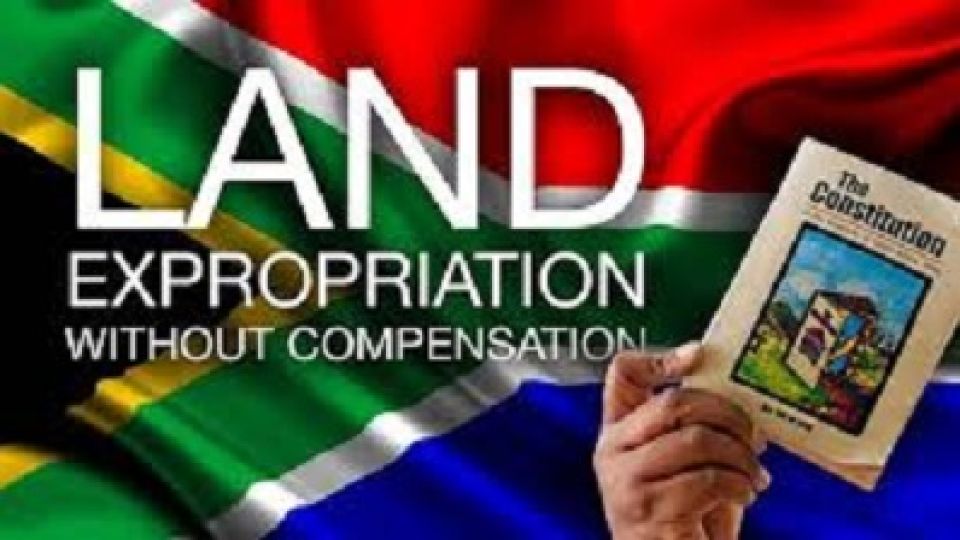
President Cyril Ramaphosa has signed the Expropriation Bill into law, in the process angering partners in the “government of national unity” and ironically, those that have always advocated for the expropriation of land, which largely remains in the hands of the minority white, more than three decades after attainment of independence.
The new law sets out how organs of state may expropriate land “in the public interest for varied reasons,” with compensation.
The legislation, which repeals the pre-democratic Expropriation Act of 1975, aligns expropriation processes with the constitution and marks the culmination of a five-year process of public consultation and parliamentary deliberation, according to the president’s office.
“Local, provincial and national authorities will use this legislation to expropriate land in the public interest for varied reasons that seek, among others, to promote inclusivity and access to natural resources,” Ramaphosa’s office stated.
Land is an emotive issue in South Africa.
A majority of the people, mainly indigenous black community, remains landless while the minority white controls over 90 percent of the arable land, whose interests the Democratic Alliance (DA) is accused of championing.
The DA is the largest partner of the African National Congress (ANC) in the coalition government, after winning 21,81 percent to the ANC’s 40,18 percent in the last election in May 2024.
Also known as the government of national unity (GNU), it is a culmination of the 2024 elections where no party, including the ANC that has been in power since 1994, failed to garner an outright majority.
The DA has reacted with anger, in what is seen as the biggest threat to the survival of the coalition government.
The Freedom Front Plus (FF+), a minor member of the coalition (1,3 percent of the vote), said to be championing the interests of Afrikaners, is also opposed to the new law of land appropriation.
The Inkatha Freedom Party (IFP), which is majorly Zulu, the largest tribe in South Africa, is also a partner in the coalition government (3,82 percent of the vote) and is opposed to the expropriation law.
The DA has declared a formal GNU dispute over the enactment of the Expropriation Bill while equally resisting the recently enacted National Health Insurance (NHI) bill.
The DA, the largest partner of ANC in the GNU, accuses Ramaphosa of disregarding constitutional objections over the Expropriation Bill, raised by Public Works and Infrastructure Minister Dean MacPherson, a DA member.
“He (Ramaphosa) failed to even inform the minister about when he intended to sign the bill into force,” said John Steenhuisen, leader of the DA.
Steenhuisen is Minister of Agriculture in the coalition government.
FF+ president, Pieter Groenewald, has threatened to approach the Constitutional Court over the Expropriation Act, challenging it as unconstitutional.
“All South Africans as well as everyone in any democratic dispensation have the right to own property, and the government has no right to expropriate it without market-related compensation,” Groenewald said.
He is the Minister of Correctional Services.
Section 80 of the Constitution determines that a third of the members of the National Assembly may apply to the Constitutional Court to obtain an order that a parliamentary law is unconstitutional.
This has to be done within 30 days after the date on which the president signed and promulgated the law.
Opponents stand little chance, with Ramaphosa’s administration accused of “capturing” the judiciary.
The IFP said it rejected the decision of Ramaphosa to sign the Expropriation Bill into law.
“This decision undermines the spirit of consensus and collaboration that is fundamental to the GNU framework,” Mkhuleko Hlengwa, IFP national spokesperson.
Hlengwa is the Deputy Minister of Transport.
The IFP also hinted at a legal challenge.
Feathers have been ruffled outside the coalition government, including parties that advocate for the expropriation.
The Economic Freedom Fighters (EFF), the fourth largest party (9,52 percent), has been the fiercest advocate for land expropriation but wants it to be done so without compensation, hence it calls the new law as “cosmetic.”
“The Expropriation Act is, therefore, a legislative cop-out by the ANC, and only used to fool our people into believing that the party is doing something to address the almost tyrannical neglect of the land question in this country,” EFF stated.
The uMkhonto weSizwe (MK) Party of former president of the country and ANC, Jacob Zuma, also rejected the enactment of the Expropriation Bill.
“This legislation, disguised as a solution to South Africa’s land question, is nothing but a continuation of injustice and a betrayal of our people’s struggles for true land restitution,” stated Nhlamulo Ndhlela national spokesperson.
MK, only formed at the end of 2023, is officially the largest opposition in the National Assembly (14,58 percent).
Access to land and resources remains a pipe-dream for the majority of blacks in South Africa, with the economy still in the hands of the white minority, more than 30 years after independence.
Poverty reigns among the majority, earning the country of 64 million the unenviable tag as the most unequal society in the world.
Critics accuse ANC of prioritizing corruption and its leaders of focusing on self –enrichment schemes at the expense of service delivery and addressing apartheid imbalances.
– CAJ News