
from MARIA MACHARIA in Nairobi, Kenya
Kenya Bureau
NAIROBI, (CAJ News) – PROTESTS over a recent hike in fuel prices have left at least four people dead in Kenya as state security again responds heavy-handedly to anti-government demonstrations.
More than 30 people have been injured and over 300 arrested following the raging protests that erupted on Monday in the capital, Nairobi, before spreading to other parts of East Africa’s largest economy.
Chief Inspector Dishen Angoya, Nairobi Central Station Police Commander, has been arrested, detained and hospitalised due to injuries sustained after releasing some 64 protesters on police bond on Monday.
Police are accused of firing live ammunition at protesters, mainly youths who heeded calls by the Transport Sector Alliance to demonstrate.
In scenes reminiscent of the so-called Gen Z protests that have rocked Kenya since 2024, there has been widespread looting, arson and destruction of property.
Schooling has again been disrupted amid the mayhem.
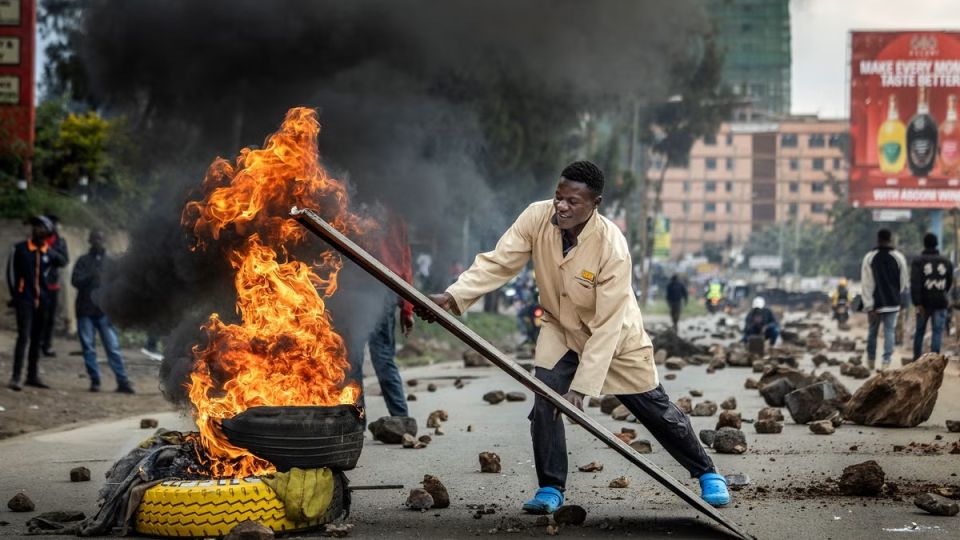
The fuel strike began peacefully but quickly degenerated into violent protests marked by road barricades made of boulders and bonfires, as well as burning tyres.
Marauding gangs have attacked motorists and members of the public who did not heed the call to strike.
This does not bode well for President William Ruto and his government as they seek re-election in the 2027 general elections.
Ruto assumed power in a disputed election against the now-deceased former prime minister, Raila Odinga, in 2022 with a pledge to tackle the country’s economic challenges. He branded himself a “hustler” to highlight his humble beginnings as a roadside chicken seller.
However, many Kenyans, the majority of them youths, are disillusioned with his presidency, as witnessed by the recurrent protests against the economic fallout and accusations of ruling the country with an iron fist.
Kenya’s fifth president, aged 59, further incurred the wrath of critics when he congratulated English football side Arsenal for winning the league title after a drought of 22 years.
Ruto congratulated the club from Kazakhstan, where he is on a state visit, while remaining tight-lipped on the crisis back home, some 6 000km away.
Joe Bassey, a commentator, accused the president of misplaced priorities.
“Even as people protested against fuel hikes, with your police killing several people and injuring many, you did not speak up. Yet you found time to speak about Arsenal winning the league,” Bassey told the leader.
Kenya’s fuel prices reached a record high last Friday.
The diesel price increased by 23,5 percent and petrol by 8 percent.
Petrol now costs Sh214,25 (over US$1,65) per litre and diesel Sh232,86 (US$1,79) per litre.
The government has attributed the increase to the Iran war. Kenya imports most of its fuel from the Middle East.
Human rights groups have condemned the government’s crackdown on protesters.
The Law Society of Kenya and the Police Reforms Working Group are among the aggrieved organisations.
“At this critical moment, the National Police Service and the Executive must act strictly within the law, adhere to the principles of legality, necessity, proportionality and accountability, and avoid the excessive use of force,” they jointly stated.
The Law Society of Kenya recently approached the High Court to challenge the legality of the current petroleum pricing regime.
Police have accused the organisers of staging “economic sabotage.”
Kenya descended into protests in 2024 after youths decried corruption, police brutality and the high cost of living. More than 60 people were killed as state security forces opened fire on demonstrators. The protests spilled into 2025.
Thus, after months of relative calm, the country is once again a powder keg.
– CAJ News