
by TINTSWALO BALOYI
JOHANNESBURG, (CAJ News) – EXPERTS have widely warned that increased competition and conflict over water are likely in the future due to climate change, population growth, pollution and overuse.
For South Africa, in particular in Johannesburg, that future is now.
This as taps run dry and the situation culminates into societal tension.
At least one death has been reported in the fight over water, a scarce commodity as the country experiences deadly floods, ironically.
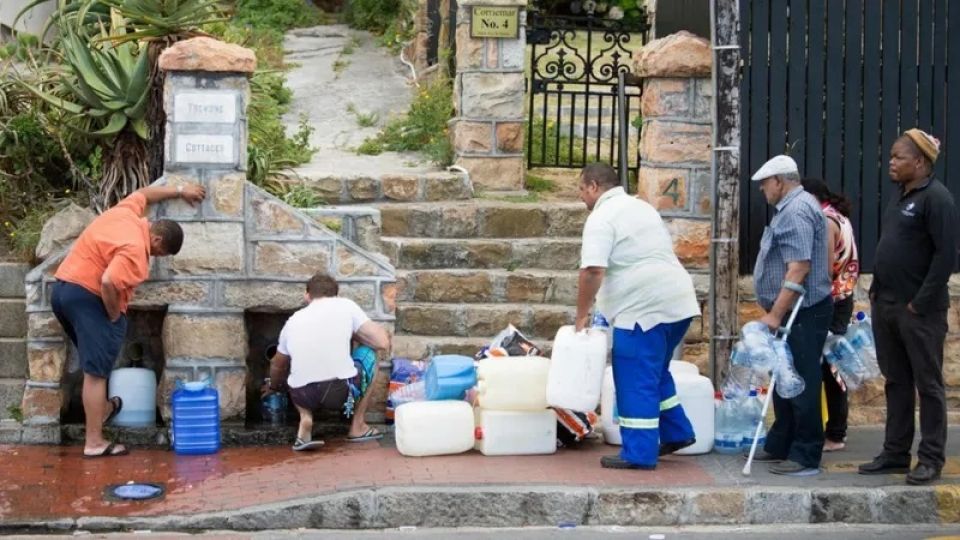
Residents scuffle over the few drops that beleaguered authorities have made available to restive crowds at makeshift water collection points.
Earlier this week, police arrested an elderly man (aged 71) for allegedly shooting dead a 33-year-old man to death during a dispute at a water tank in Delmas, near Johannesburg.
A police report states that the two were staying in the same premises, with the older man the landlady.
South African Police Service (SAPS) further disclosed that due to ongoing water shortages, the landlord had installed a JoJo tank in the garage to be used when municipal water was unavailable.
The JoJo tank was situated on the suspect’s side of the premises.
Police report the deceased attempted to enter the garage to switch on the pressure pump to access water.
The suspect reportedly refused him entry. The deceased then allegedly forced his way to the tap, at which point the suspect shot him at close range, striking him in the left eye.
More than 100 community members gathered at the scene and became extremely angry following the incident.
“They allegedly threatened to kill the suspect and burn down the house. He was immediately arrested,” police stated.
The JoJo tank, manufactured by a company of the same name, is arguably the most prominent tanks in South Africa, storing up to 20 000 litres of water at maximum and can be filled up at the rare occasion water is available.
These high-end tanks can retail for between R20 000 (US$1 259) and R50 000. They are a luxury in this water-scarce country, especially amid the ongoing water cuts.
The economy is too constrained for the majority to afford such.
That murder in Delmas is a tip of the iceberg as the situation threatens to get out of control, with Johannesburg the epicentre of the crisis.
“When people are forced to compete for water, dignity collapses and conflict becomes inevitable,” the non governmental organisation, WaterCAN, warned.
The crisis is muddying Johannesburg’s self-given status as “a world-class African city.”
Some schools frequently send children home. Some companies have also adopted a work-from-home policy, last implemented at the height of COVID-19.
Some impoverished areas in Johannesburg have been experiencing water problems for months, but the situation has only caught public attention now that some middle-class parts, such as Midrand, and the almost-always restive Soweto are now affected.
The situation is volatile and scuffles intermittently break out over scant water at makeshift water collection points.
Rand Water, the parastatal, and Joburg Water, for example, use bowsers (mobile water tankers) to deliver the precious liquid.
In some informal settlements, that are majority South African, residents have physically fought over limited supplies from water tankers.
Confrontations have been reported in Patsing and Waterworks.
“Tankers arrive intermittently or with insufficient supply,” lamented a community leader.
The situation has also been tense in the areas of Hillbrow and Yeoville, which are dominated by Africans from outside the country.
Residents initially queue but there are intense jostles as the queue disintegrates into chaos when tanks turn up.
There is similar pandemonium as residents also scuffle to collect water from burst pipes. An estimated 33 percent of water is lost through leaks.
In Soweto, the water crisis has added to the hardship faced by residents that had already been grappling with so-called load shedding, power cuts lasting at least five hours per session.
After claiming land shedding was ended in 2024, power utility Eskom, has quietly implemented load reduction in these areas where there is high demand at peak hours.
Among the areas affected is Protea Glen, west of Soweto.
“This place is hell. If it’s not the issue with power cuts, it’s the throttling of the water or authorities failing to supply completely. Promises of water tankers delivering have not been fulfilled,” resident, Nyaniso Mngadi, bemoaned.
WaterCAN stated, “This is a direct consequence of inadequate planning, erratic tanker deliveries and the absence of clear rules or oversight at distribution points.”
A strike by Joburg Water workers exacerbated the situation. They returned to work on Wednesday but that did not change anything.
On Wednesday night, the company stated its systems remained constrained due to “poor incoming supply.”
“The team is planning the necessary interventions to build capacity and aid recovery on affected systems,” it stated.
“Further updates will be provided as soon as they are available,” Joburg Water added.
Pemmy Majodina, the Minister of Water and Sanitation, blamed the crisis on ailing water infrastructure.
“It’s not a deliberate move to deny the people of Gauteng water,” she addressed the media.
Majodina said approximately R400 billion (US$25,18 billion) was needed to repair and upgrade water infrastructure at the local government level.
Gauteng, South Africa’s economic powerhouse, is where Johannesburg is located.
Panyaza Lesufi, premier of the province, infuriated residents when he disclosed, during a briefing, that amid the shortages, he goes to a hotel to take a bath.
That is a pipedream to a majority.
Lesufi issued an apology late on Wednesday for his statement.
Politicians spoke as residents and business owners from various suburbs of Johannesburg took to the streets in protest against the outages.
– CAJ News